The FIRE Framework
A practical guide to earning, saving, investing, and owning your time.
It surprises me how many people earn six figures, live comfortably, and are still just one lost paycheck away from financial trouble.
You can have an impressive salary, a great career, and still have very little freedom.
That’s what I want to change.
I’ve always thought this was stupid.
You should be financially prepared to lose your job tomorrow.
Not because you expect it, but because being prepared gives you freedom. You can leave a job you hate, take risks, start a company, or simply spend your time doing something you actually care about.
And ironically, I think this makes you a better employee, too. When you’re not terrified of losing your job, you’re much more comfortable challenging decisions, disagreeing with leadership, and speaking your mind.
That’s what financial independence means to me. Not necessarily retiring early, but having control over my time and decisions.
I started learning about personal finance as a teenager, and eventually built enough savings and investments to cover the living expenses of my entire family, including myself, for over a decade.
This guide is everything I wish I’d understood when I started.
It’s open source, and contributions are welcome.
The three skills of building wealth
Making money, saving money, and investing money are three different skills.
You can be an excellent engineer earning $200K a year and still be broke. You can be a great saver but leave your money sitting in cash for decades, losing purchasing power to inflation.
You need to understand all three.
Earning is about becoming valuable. Develop skills people are willing to pay for, negotiate your compensation, and look for opportunities that increase your earning potential.
Saving is about controlling how much of that income you actually keep.
Investing is about putting those savings into assets that can grow over time.
The more you earn, the more you can save. The more you save, the more you can invest. And the more you invest, the less dependent you become on your next paycheck.
Simple enough.
Spend less than you earn
One of the biggest financial mistakes you can make is increasing your spending every time your income increases.
You get a raise, move into a nicer apartment, buy a more expensive car, and suddenly you’re earning twice as much but saving exactly what you were before.
What’s the point?
I’ve always preferred keeping my living expenses relatively low, regardless of how much I earn.
Not because I enjoy depriving myself, but because I value freedom more than expensive things.
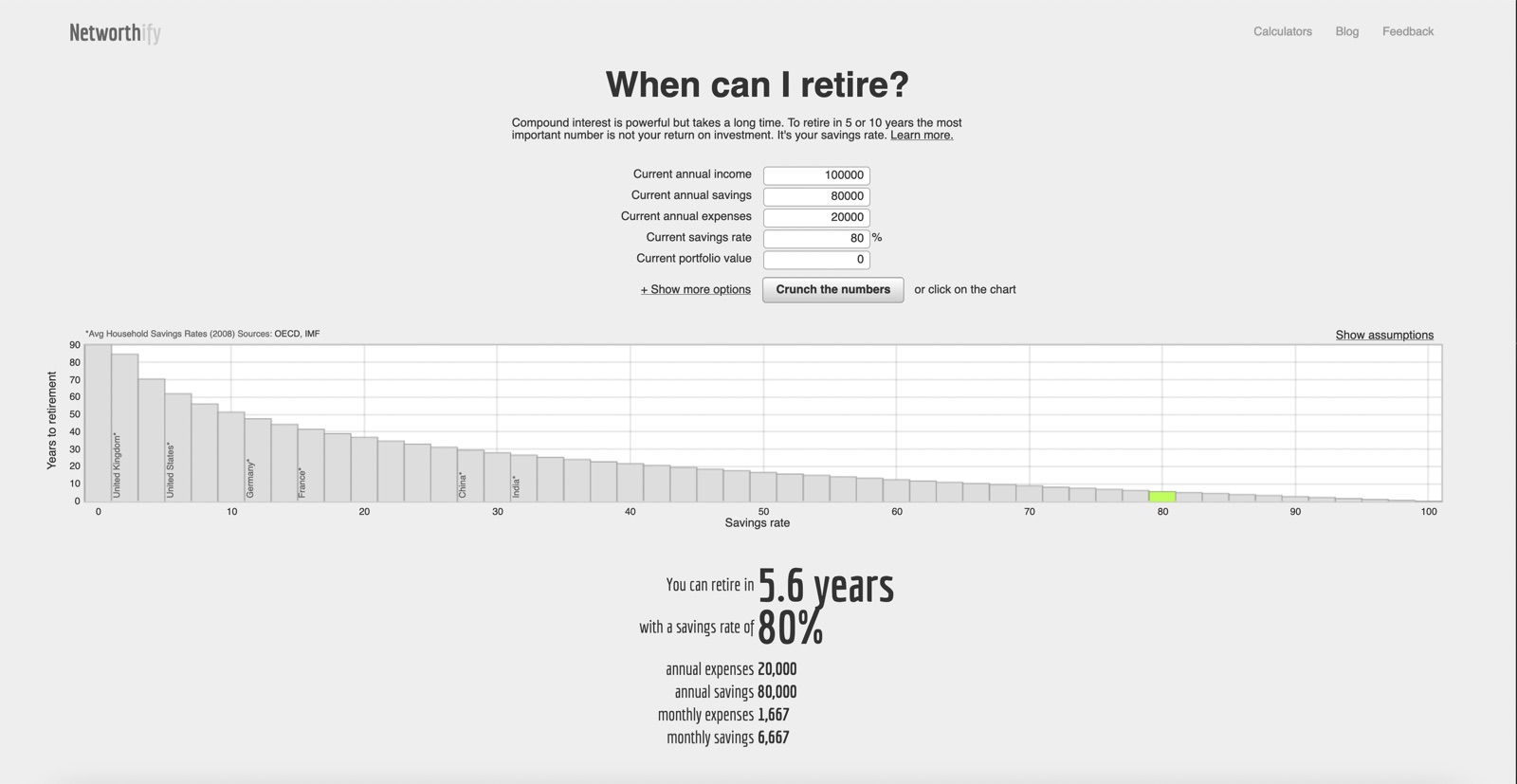
Consider someone earning $100K after taxes and spending $20K annually.
They’re saving $80K a year, enough to cover four years of their current living expenses.
Of course, that’s before inflation, investment returns, taxes on investments, and unexpected expenses. But the point remains: one year of work can buy you several years of freedom.
That’s an incredible tradeoff.
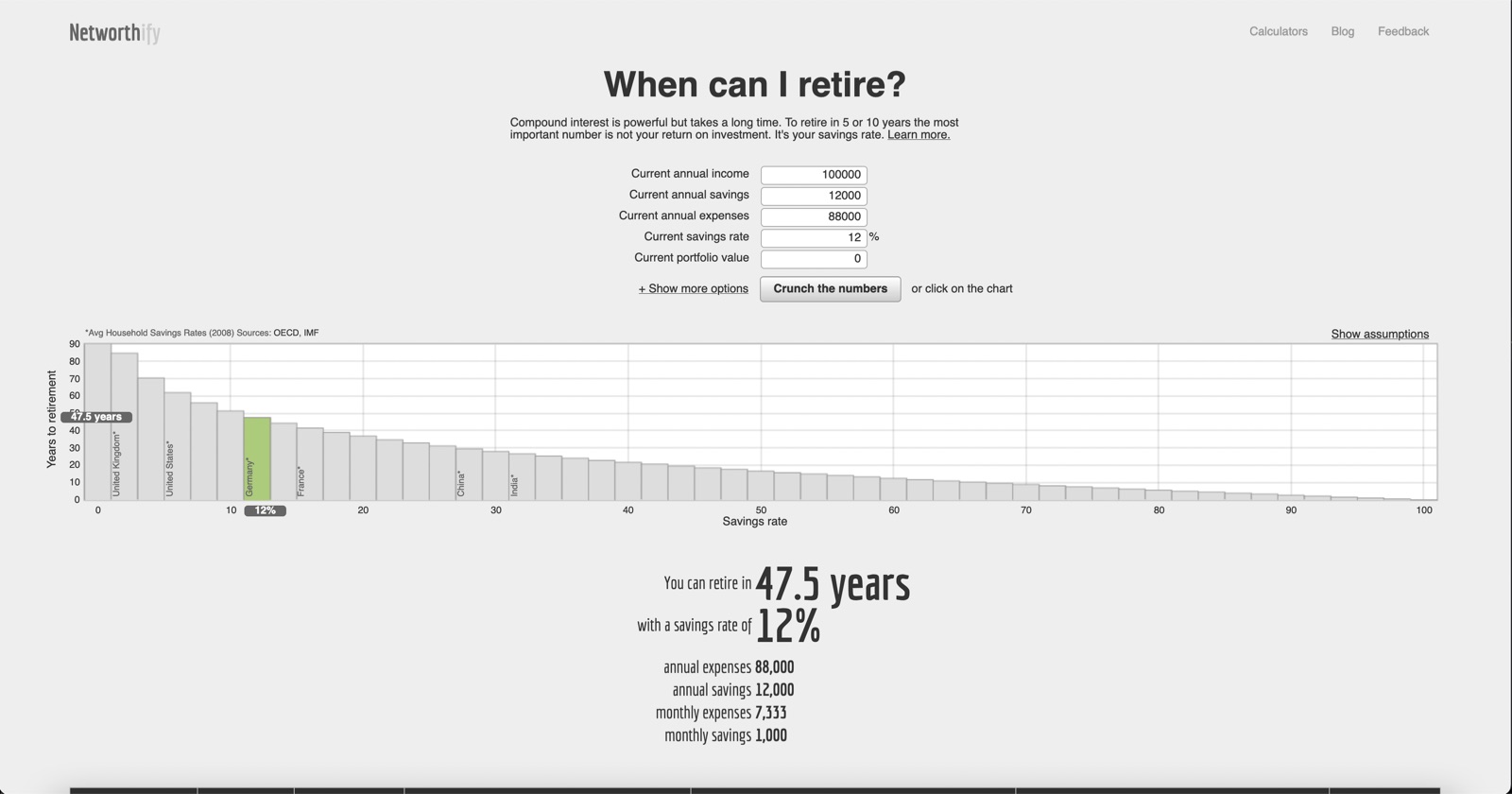
Your savings rate matters enormously. Here’s what the difference between saving 12% and 80% of your income looks like:
You don’t need to live on $1,000 a month. Your expenses depend on where you live, your family, and what makes you happy.
But you should understand what you’re giving up every time you increase them.
And please, don’t sacrifice your health to save money. Eat well, exercise, and take care of yourself. There’s little point accumulating wealth if you’re too unhealthy to enjoy it.
Build your independence fund
Before worrying about becoming a millionaire, figure out how much money you need to survive without your next paycheck.
Start with an emergency fund.
For many people, 3–6 months of essential expenses is a reasonable starting point. If your income is unpredictable, you support family members, or finding another job would take longer, you might want considerably more.
Keep this money somewhere safe and accessible.
Then start building what I call your Independence Fund.
The idea is simple: accumulate enough savings and investments that you can make career and life decisions without constantly worrying about your next paycheck.
How much do you need?
That depends on your expenses.
| Annual expenses | 1 year of expenses | 5 years of expenses | 25× annual expenses |
|---|---|---|---|
| $12,000 | $12,000 | $60,000 | $300,000 |
| $24,000 | $24,000 | $120,000 | $600,000 |
| $36,000 | $36,000 | $180,000 | $900,000 |
| $60,000 | $60,000 | $300,000 | $1,500,000 |
These are simple expense multiples, not guarantees that your money will last a particular number of years.
The popular 4% withdrawal rule uses approximately 25 times your annual expenses as a starting point for retirement planning.
But it was developed around historical retirement scenarios, typically spanning about 30 years. If you’re planning to become financially independent in your 20s and potentially fund another 60 years of living expenses, you need to be more conservative.
Personally, I think financial independence is a spectrum.
Having six months of expenses gives you some breathing room.
Having five years gives you considerably more freedom.
Having enough invested to potentially support you indefinitely changes your relationship with work entirely.
You don’t need to reach the final stage before enjoying the benefits.
Investing without overcomplicating it
Once you’ve built your emergency fund and dealt with expensive debt, you can start investing money you won’t need in the near future.
You don’t need to become a professional trader.
In fact, for most people, trying to outperform the market by picking individual stocks is probably a waste of time.
I’d rather own a diversified portfolio of businesses and spend my time doing something else.
Stocks and index funds
When you buy a stock, you own a small part of a company.
When you buy a broad index fund, you own small parts of many companies.
For example, an S&P 500 index fund gives you exposure to approximately 500 large American companies.
Rather than guessing which individual company will succeed, you’re investing in a broad collection of businesses.
An ETF is a fund traded on an exchange. Many ETFs track indexes, although not all do.
Personally, I’ve favored low-cost index funds because they’re simple, diversified across many companies, and don’t require constantly monitoring individual stocks.
That doesn’t mean they’re risk-free.
Stock markets can fall dramatically, and recovering from a crash can take years. You should never assume money invested in stocks will be available at a favorable price whenever you need it.
Asset allocation
How much should you invest in stocks, bonds, or cash?
There’s no universal answer.
It depends on your age, expenses, investment horizon, and how much volatility you can tolerate.
Someone investing for 30 years can generally afford to take more market risk than someone planning to spend their savings next year.
A portfolio of 100% stocks may offer substantial long-term growth potential, but it can also experience severe drawdowns.
Adding high-quality bonds or cash can reduce some risks, although it introduces others, including inflation and reinvestment risk.
The important thing is to understand what you own and why.
Don’t build a portfolio that looks great in a spreadsheet but makes you panic during a market crash.
Compound growth
Suppose you invest $10,000 and earn an average annual return of 7%.
After 10 years, you’d have approximately $19,700.
After 20 years, around $38,700.
After 30 years, approximately $76,100.
That’s without contributing another dollar.
Of course, actual market returns aren’t consistent, and these figures ignore taxes, fees, and inflation.
But they illustrate why starting early matters.
Your money has more time to grow, and future returns can build on previous returns.
What about real estate?
Real estate can be a great investment, especially when rental income helps cover the property’s expenses.
But don’t assume buying is always better than renting.
Property comes with maintenance, taxes, transaction costs, vacancies, and the risk of having a large amount of money tied up in one asset.
Mortgages introduce leverage, which can amplify both gains and losses.
Run the numbers.
Sometimes buying makes sense. Sometimes renting and investing the difference is the better decision.
Understand your taxes
Taxes can have an enormous impact on how quickly you build wealth.
And yet, many people spend years optimizing their investments while barely understanding how their income is taxed.
I’ve always found that strange.
Learn the tax rules that apply to you.
Understand your tax residency, available deductions, retirement accounts, investment taxes, and any relevant international tax treaties.
If you work remotely or live internationally, this becomes even more important.
But be careful with advice about offshore companies and digital nomad tax strategies.
Living abroad doesn’t automatically eliminate taxes
There’s a popular idea that you can avoid tax residency simply by spending fewer than 183 days in every country.
That’s dangerously oversimplified.
Countries have different residency tests. Some consider your permanent home, family, economic interests, or other connections.
You can become tax resident somewhere without spending 183 days there, and leaving a country doesn’t necessarily terminate your existing tax obligations.
Similarly, opening a company in a low-tax jurisdiction doesn’t automatically mean your business income becomes tax-free.
Where you manage the company, where you perform the work, and where you’re personally tax resident can all matter.
If you’re considering international tax planning, speak with a qualified professional who understands the jurisdictions involved.
U.S. investments for non-U.S. investors
If you’re investing in American stocks from outside the United States, there are a few things worth understanding.
Dividends: U.S. dividends paid to nonresident investors are generally subject to 30% withholding, potentially reduced by an applicable tax treaty. Form W-8BEN is commonly used by eligible individuals to establish foreign status and claim treaty benefits.
Capital gains: Nonresident investors are often exempt from U.S. federal capital gains tax on ordinary stock sales, but important exceptions exist. Your country of tax residence may also tax those gains.
Estate tax: Non-U.S. citizens who aren’t U.S.-domiciled can face U.S. estate tax exposure on certain U.S.-situated assets. The filing threshold can be as low as $60,000, although treaties and other rules may change the outcome.
That last point is particularly important.
You could live outside the United States your entire life and still leave your heirs with an unexpected U.S. estate tax problem.
Some investors consider non-U.S.-domiciled funds or other ownership structures to manage this exposure. The appropriate approach depends on your circumstances, and structures can introduce their own costs and tax consequences.
Don’t blindly follow advice telling you to open an offshore company.
Understand the problem first.
Know when you have enough
There’s another financial trap I think people underestimate.
You spend years working toward $100K.
Then you want $500K.
Then $1M.
Then $5M.
At what point do you actually stop and enjoy what you’ve built?
I’m not saying ambition is bad. I have plenty of it myself.
But if the goalposts keep moving, you can spend your entire life accumulating money without ever enjoying the freedom it was supposed to buy.
Figure out what you actually want.
Maybe it’s spending more time with your family. Starting your own company. Traveling. Working on open-source projects. Or simply not having to worry about paying rent.
Your financial goals should support those things, not replace them.
I also think there’s nothing wrong with wanting to leave money to your children or support people around you.
Personally, I believe money is a tool that can improve other people’s lives, not just your own.
Whatever you decide, stay humble and kind.
Having money doesn’t make you better than anyone else.
Getting started
If you’re starting from zero, here’s how I’d approach it.
First, understand your finances. Figure out how much you earn, spend, owe, and save every month.
Second, eliminate expensive debt. High-interest debt can destroy your finances faster than most investments can grow them.
Third, build an emergency fund. Keep enough money accessible to handle unexpected expenses and income interruptions.
Fourth, start investing. Learn about diversified, low-cost funds and choose an allocation appropriate for your circumstances.
Finally, automate what you can. Consistently investing part of your income is generally more useful than obsessing over the perfect time to enter the market.
Choosing a brokerage
You’ll need a brokerage account to buy stocks and ETFs.
I personally use Interactive Brokers, but there are plenty of alternatives depending on where you live.
Before opening an account, compare fees, available investments, regulatory protections, and tax reporting.
Once you’ve chosen a brokerage, the process is generally straightforward: open an account, complete identity verification, fund it, and place your first investment order.
You don’t need thousands of dollars to start. Many brokers support fractional shares.
One important distinction: brokerage investor protection generally addresses certain failures involving missing customer assets. It doesn’t protect you from losing money because your investments fall in value.
And don’t spend months trying to identify the perfect investment.
Spend that time learning enough to make a reasonable decision, then build a strategy you can actually stick to.
Final thoughts
I wrote this guide because I think too many people spend their entire lives financially dependent on their next paycheck.
You shouldn’t have to tolerate a job you hate, abandon an idea you believe in, or stay somewhere you’ve stopped growing simply because you can’t afford to leave.
Financial independence doesn’t happen overnight. It takes discipline, patience, and often years of work.
But you don’t need millions to start benefiting from it.
Every month of expenses you save gives you a little more freedom.
And ultimately, that’s what I’ve always wanted.
Not necessarily to stop working, but to never have to work on something I don’t believe in just to survive.
This guide is educational and reflects my personal experiences and opinions. It isn’t individualized financial, investment, legal, or tax advice. Investment returns aren’t guaranteed, and tax rules vary by jurisdiction. Verify important details and consult qualified professionals where appropriate.
The guide is open source on GitHub. If you find something inaccurate, outdated, or worth improving, open an issue or a pull request. Licensed under Creative Commons Attribution-ShareAlike 4.0 International.